
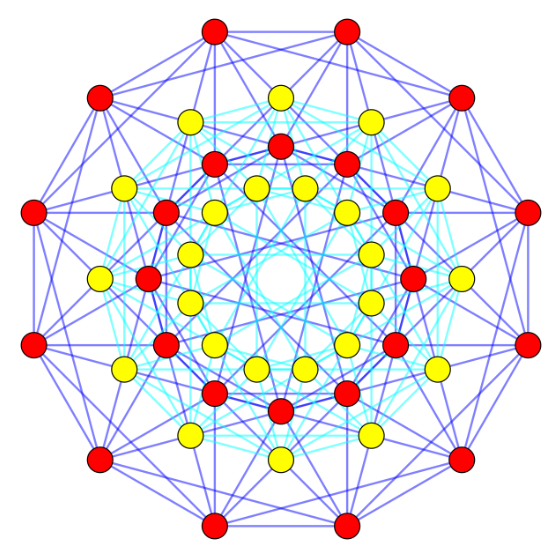
Langlands Correspondence for the p-adic group F4 and representations of a p-adic group
Date(s) : 27/11/2026 iCal
14h15 - 18h15
Composition of the Jury :
Anne-Marie AUBERT – Reviewer
Sandeep VARMA – Reviewer
Simon RICHE – Committee Chair
Gaëtan CHENEVIER – Examiner
Dan CIUBOTARU – Examiner
Jean-Loup WALDSPURGER – Examiner
Volker HEIERMANN – Ph.D. Advisor
Abstract :
The Langlands Correspondence builds bridges between objects from two different mathematical worlds: on the one hand, the Galois group of a number field or its p-adic version, and on the other hand, linear algebraic groups defined over this field. The correspondence predicts a bijection between representations of these groups that satisfy certain constraints. In the p-adic case, we have fairly or very precise results for the general linear group as well as for the classical groups and their inner forms. In contrast, for the so-called exceptional groups (classified according to their root systems of types E6, E7, E8, F4, and G2), everything or almost everything remains open. A major advance in this direction is the work of Anne-Marie Aubert and Yujie Xu, who constructed an explicit Local Langlands Correspondence for the exceptional reductive group of type G2, over a non-archimedean local field of residual characteristic different from 2 and 3. Their approach combines several techniques including the theory of affine Hecke algebras, the theory of Bernstein blocks, and the generalized Springer Correspondence. During my defense, I will explain the work I have carried out over the past four years under the supervision of V. Heiermann with the aim of adapting the method developed by A.-M. Aubert and Y. Xu to the case of the split p-adic reductive group of type F4.
Keywords: Langlands Program, Local Langlands Correspondence, Representations of p-adic Groups, Exceptional p-adic Group of Type F4
Emplacement
I2M Luminy - TPR2, Amphithéâtre Herbrand 130-134 (1er étage)
Catégories